Almost a week ago, it was still pretty cold when I was walking along the Rideau River.

Male Mallard (Anas platyrhynchos)




 Not cloudy at all.
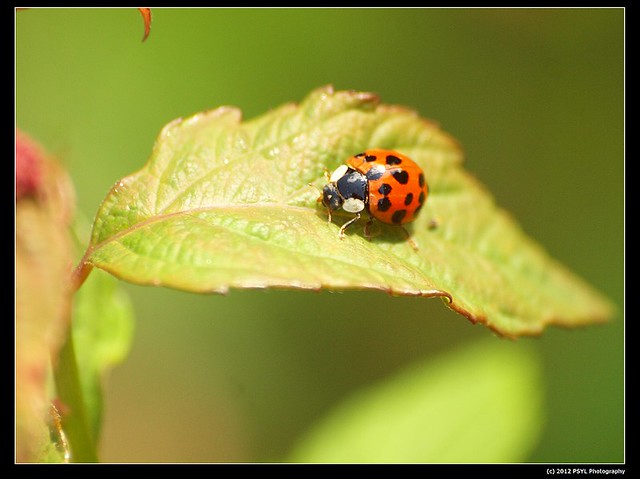
 My first ladybug of the year. It has 19 spots (2, 3, 3, 1 on each side, from anterior to the end; and one spot right in the middle); therefore, this is a 19-Spotted Ladybug (Harmonia axyridis). It was walking along the railings of a dock. It seemed to have trouble walking against the wind, so I gently nudged it towards a depression where it can hide.

 Another of its own.

 A gray day today.

 Barn swallows are back! I hope they are here to enjoy the bugs that gets in my way when I rode my bike along the dyke. Many of them flew to my face and cloth and rested there. Kind of annoying!
 I hope I am right with my identification since there are a couple of lizards in the family Lacertidae found in Taiwan, and they all looked quite similar to me in the field guide. One main distinction is that T. formosanus has two pairs of inguinal pores, but I didn't want to stress and pick up this little fellow up to examine it more closely.

 Today is Sunday, and it is my mother's last day in Taipei. My mother, aunt, and I went shopping in the neighbourhood before we brought my mother to the train station to head back to Central Taiwan. I will not see my mother again for another three months, since she is heading back to Canada in a couple of days while I'm still staying for my volunteer work and internship. Sigh.

 Tree Swallow looking for nesting materials.
 Entering and Exiting
 A tiny ground beetle (about 10mm in length) was saw running across the gravels.


 A partially leucistic American Robin with white spots on its head.


 The different types of habitats (for all kinds of birds) in Paulik Garden.
 A butterfly "hotel" for the non-migratory butterfly species (during the winter) here in Lower Mainland.
 One of my favorite things to do now - exercise my neck by looking up magnificent tall trees and taking pictures.

 A bird that seems to be a robin, but it doesn't have that bright orange breast, so I am quite confused now. Maybe it's a different species all together.

 Slug

 However, the most exciting sighting of the day was this pair of muskrats (Ondatra zibethicus) - a medium-sized, brown, aquatic rodent that build dens on the water just like beaver. But one distinguishable characteristic is their vertically flattened tail, which was clearly observed when I was watching them swim. They were feeding on some kind of plants in the pond. Never seen a muskrat in person, I was running around the pond trying to get decent picture with my digital camera. And these were the best that I got.


 The first spot that I checked out was Minoru Park which homes many waterfowls this fall, such as these Canadian Geese, Mallards, and Wigeons.
 One sad scene at the park was seeing this deceased duck lying on the surface of the water, a casualty of the not yet arrived harsh seasons ahead. Not sure what the cause of death is but I sure hope it is not due to some diseases and that the city people come remove it soon (so that it won't contaminate the water). R.I.P.
 I saw about five rabbits in the park today, which was more than last time that I was here. I don't have a good feeling about this whole situation. Sure they are cute, but I don't think overpopulation of another species (besides humans here in Richmond) will be welcomed.
 To take my mind off these depressing issues that I saw in the park, I decided to pay attention to the beautiful and cheerful colours in the park.
 Then I saw this pretty ladybug, but it was hiding in the shade so I nudged it to get it to move to a brighter spot. I accidentally flipped too hard and it flipped over so I quickly returned it to the more comfortable position.
 Afterwards, I walked from Minoru Park to the community park in Garden City to check out the Hooded Mergansers that Hugh of Rock Paper Lizard observed - which I don't think I have ever seen one before.
 There were also many fungi here in the community park. I never noticed them before, but Richmond does have many fungi in the fall.
 There were also these mysterious cream puff look-alike fungi?
 Now, I finally got to the Hooded Mergansers (Lophodytes cucullatus)! These birds are fish-eaters and nest in tree cavities just like the Wood Ducks. The male can be identified by its black and white crest while the female has a grayish brown and shorter crest. They dive underwater to find food, and they can do so because they can change the optical refractive properties to enhance their underwater vision, as well as having a third eyelid (called nictating membrane) to act as a pair of goggles for eye protection.
 I saw two males and one female in the main body of the "lake" and they were so far away (with my camera) that I decided to walked around the park one last time before heading home. But then I observed two females in an isolated and smaller "pond" at the outer edge of the park (and right across from residential areas too). Being in a smaller space, I ran back and forth as they dive away from me so that I can take some up-close pictures - which didn't turn as good as I hoped. I noticed the crest falling whenever they came right out of the water but then the crest raised right back up, it must be cool to have waterproofed "hair". My mom says they look like Marge of The Simpsons, but I don't really see the similarity, perhaps when Marge is dressed up for Halloween.
 And then it was time to go home.


