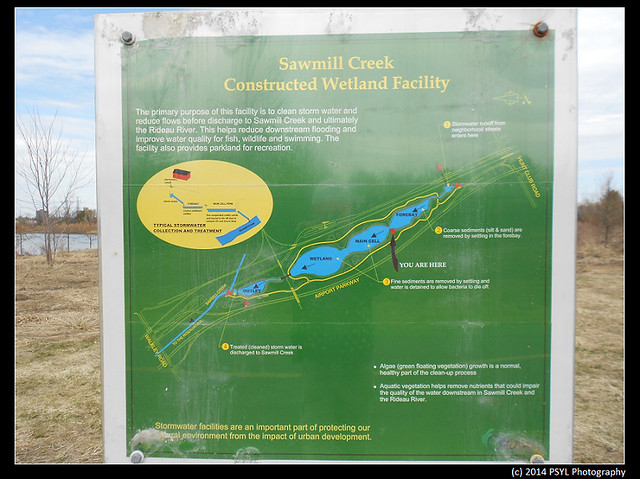
The main purposes of this man-made wetland are to collect run-off water and de-silt the water before it flows into Sawmill Creek.
 Looking for food.
 Looking around.
 Still no fishes to be found? Time to change to another location again.
 Let see if standing on top of the vegetation will give me a better view.
 Nope. How about the fishes hiding underneath the vegetation?
 I think I might go hungry this morning.


 The barbet nestlings are getting more courageous facing the outside world. Pretty soon, you will be able to see at least half of its body and they will be leaving the nest by then.
 Eventually, I allowed the wasp to carry the spider away, and last time I saw them, the wasp was dragging the spider along a branch of a shrub.


 We are continuing to record the behaviours of the barbets in this nest. We believe the nestlings (two of them, to be exact) will be leaving nest near the end of the week since the nestling(s) is poking its head out of the nest quite frequently now (i.e. getting more interested and curious about the outside world).
 Nevertheless, the nestlings (left photo) still have a lot of growing to do before it reaches the colorful plumage of its father (right photo).
 Eat this cicada and grow stronger, my children. It's time for me to find more food for you.


 Like last week, the nestlings were still hungry.
 But this time, the father (with the pink and red bands on the right) was available to provide them with food. This time it is a cicada.
 Ever since the leg-banding, the mother was rarely seen. So all the duties are performed by father now.
  It drizzled a little bit in the afternoon, so a rare rainbow in Taipei City was observed!


 Black Drongo (Dicrurus macrocercus) in the brooding stage. I love its tail!


 Since I was just visiting I did not take part of the endoscopic observation. So I can finally photograph and show you how we do it.
 The above photo is the nest entrance. As you can see, the nest is again inside a Camphor tree on a sidewalk of a busy street (second strange living places of the day). The below left photo shows one person handling the extended pole with the endoscopic equipments attached to it while another has a small screen attached to the camera and takes photographs of the latest nest status [the photograph showed 3 eggs already]. So why copulating again? The below right phot shows the camera (and LCD lights) extending into the nest cavity to record the status. Isn't it fun? This nest is relatively close to the ground so using the pole is enough. But imagine a nest at least 10 meters above the ground. That's when it gets dangerous and tricky.
 Still the same...
 The beautiful male Black-naped Blue Monarch (Hypothymis azurea) standing on its nest with two new nestlings. This nest is becoming photographers' favorite subject to shot in the garden.
 Mama cat and baby kitten

 Malay Night Heron (Gorsachius melanolophus)
 Not much seems to have progressed during the weekend.
